
Tree Roots in Your Sewer Line: Why Utah Summers Make It Worse (and How to Stop It)
Every summer, our crews get the same call across Salt Lake, Davis, and Weber counties: a toilet that gurgles, a basement floor drain that backs up after laundry, a yard that smells faintly of sewage near a big shade tree. Nine times out of ten, the culprit is the same — tree roots have found their way into the sewer line.
If you live on a mature street in Bountiful, Sugar House, Ogden, Layton, or any of Utah’s older neighborhoods lined with tall cottonwoods, maples, and poplars, this is one of the most common and most preventable plumbing problems you’ll face. Here’s what’s actually happening underground, why it ramps up in the warmer months, and what you can do about it before it becomes a backed-up mess.
Why roots target your sewer line in the first place
Your main sewer line is the single pipe that carries everything from your home out to the city sewer or septic system. It runs underground through your yard — often right past the trees you planted for shade decades ago.
That pipe carries a steady supply of warm water, oxygen, and nutrients. To a tree, that’s a buffet. Roots don’t smash through solid, healthy pipe. Instead, they sense moisture and water vapor escaping from tiny imperfections: a hairline crack, a loose joint, or a section of old clay or cast-iron pipe that has started to corrode. Once even a thread-thin root finds that opening, it grows toward the water, widens the gap, and fans out inside the pipe into a dense mat that catches grease, toilet paper, and debris.
Utah’s older homes are especially prone to this. Many properties built before the 1980s still have the original clay tile or cast-iron sewer laterals, and clay joints are practically an open door for roots.
Why summer makes it worse
In spring and summer, trees are in full growth mode and drinking hard. During Utah’s hot, dry stretches — and we get plenty of them along the Wasatch Front — the soil dries out and roots aggressively hunt for any reliable moisture source. Your sewer line is the most dependable water supply in the entire yard, so root growth toward it accelerates exactly when your household water use also climbs: more showers, more laundry, summer guests, kids home from school.
The result is a slow-building blockage that finally tips over into a full backup at the worst possible time. The good news is that the warning signs show up well before the basement floods.
Warning signs to watch for
Catch these early and you’ll save yourself a much bigger repair bill:
- Gurgling toilets or drains. Air trapped by a partial root mass escapes as bubbling or gurgling, especially when a toilet finishes flushing.
- Multiple slow drains at once. A single slow sink is usually local. When tubs, toilets, and floor drains all slow down together, the problem is in the main line.
- Drains that back up when you run a lot of water. A backup during laundry or after several showers points to a restricted main.
- Sewage odors in the yard or near a floor drain.
- Unusually green or soggy patches in the lawn following the path of the sewer line — roots are feeding on the leak.
If you’re seeing any of these, don’t reach for chemical “root killer” from the hardware store and hope. Those products rarely clear an established root mass and can damage older pipe. The reliable path is to actually look inside the line.
How we find and fix it
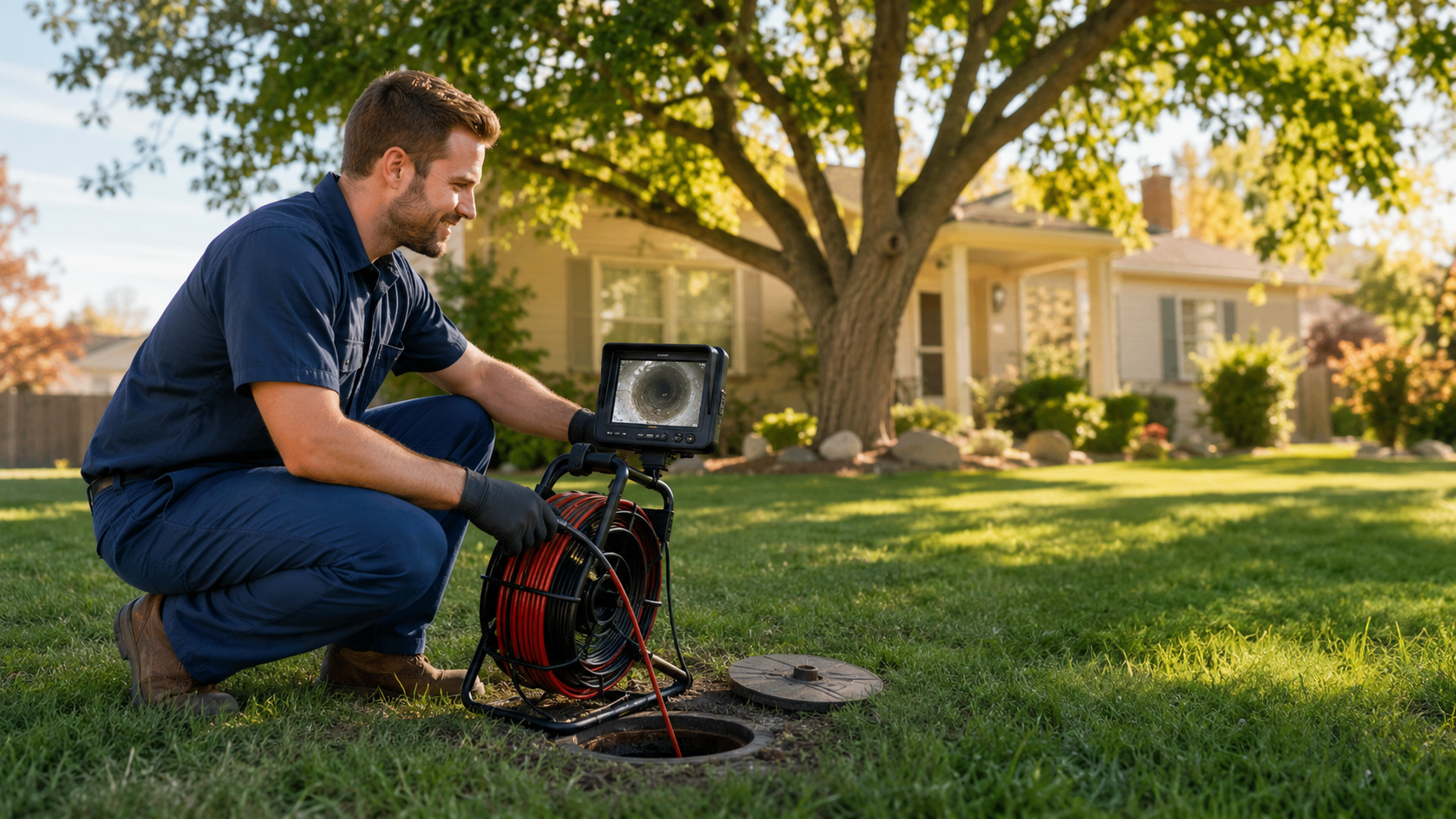
The first step is never guesswork. We run a sewer camera inspection — a waterproof camera fed down the line so we can see exactly where the roots are entering, how bad the intrusion is, and what condition the pipe is in. No digging, no assumptions, just a clear picture of the problem and a video you can keep.
Once we know what we’re dealing with, there are usually two paths:
Clear it with hydro jetting. For active root intrusion, hydro jetting is the most effective cleaning method. It uses high-pressure water — our equipment runs up to 4,000 PSI — to cut through the root mass and scour the pipe walls clean of grease, scale, and buildup that a cable snake just chops a hole through. Done right, jetting clears the line far more thoroughly and buys you much more time before roots return.
Repair or replace the damaged section. Roots only get in where the pipe is already compromised. If the camera shows cracked, collapsed, or badly offset pipe, clearing the roots is only a temporary fix — they’ll come right back through the same gap. In those cases, sewer line repair or replacement is what actually solves the problem for good, and modern trenchless methods often let us do it without tearing up your whole yard.
How to keep roots out long-term
A few habits go a long way in Utah’s climate:
- Know where your line runs and avoid planting thirsty, fast-growing trees near it. Utah State University Extension recommends keeping large trees well away from underground utilities and choosing the right species and placement for your yard — worth a read before your next planting project (USU Extension Forestry). Cottonwoods, willows, silver maples, and poplars are the worst offenders.
- Schedule a routine camera inspection if you own an older home — especially before you buy a property with mature trees, so you’re not inheriting someone else’s root problem.
- Consider periodic preventive jetting if you have a known history of roots. Clearing the line on a schedule is far cheaper than an emergency dig-up.
Don't wait for the backup
Root intrusion almost never fixes itself, and it rarely picks a convenient moment to fail. If your drains are gurgling, slowing down, or you’ve had backups before, the smart move is to look inside the line now — while it’s a quick clearing job and not a flooded basement.
Drain Kingz is a local, veteran-owned team serving homeowners across Salt Lake, Utah, Davis, and Weber counties. We’ll inspect your line, show you exactly what’s going on, and give you honest options at fair pricing. Call (801) 335-9197 to schedule a sewer camera inspection.