“Just snake it” is the most common request we get for a clogged drain, and honestly, for a lot of clogs, that’s the right call. But we get asked about hydro jetting often enough, usually by someone who’s had the same clog come back three times in six months, that it seemed worth laying out exactly what it is, how it’s different from snaking, and how to know which one your drain actually needs.
Short version: hydro jetting isn’t an upsell or the “premium” option just because it costs more than a basic snake. It solves a genuinely different problem. Whether it’s the right call for your home in Salt Lake City, Sandy, West Jordan, or anywhere else along the Wasatch Front depends mostly on what’s actually going on inside your pipe.
What Hydro Jetting Actually Is
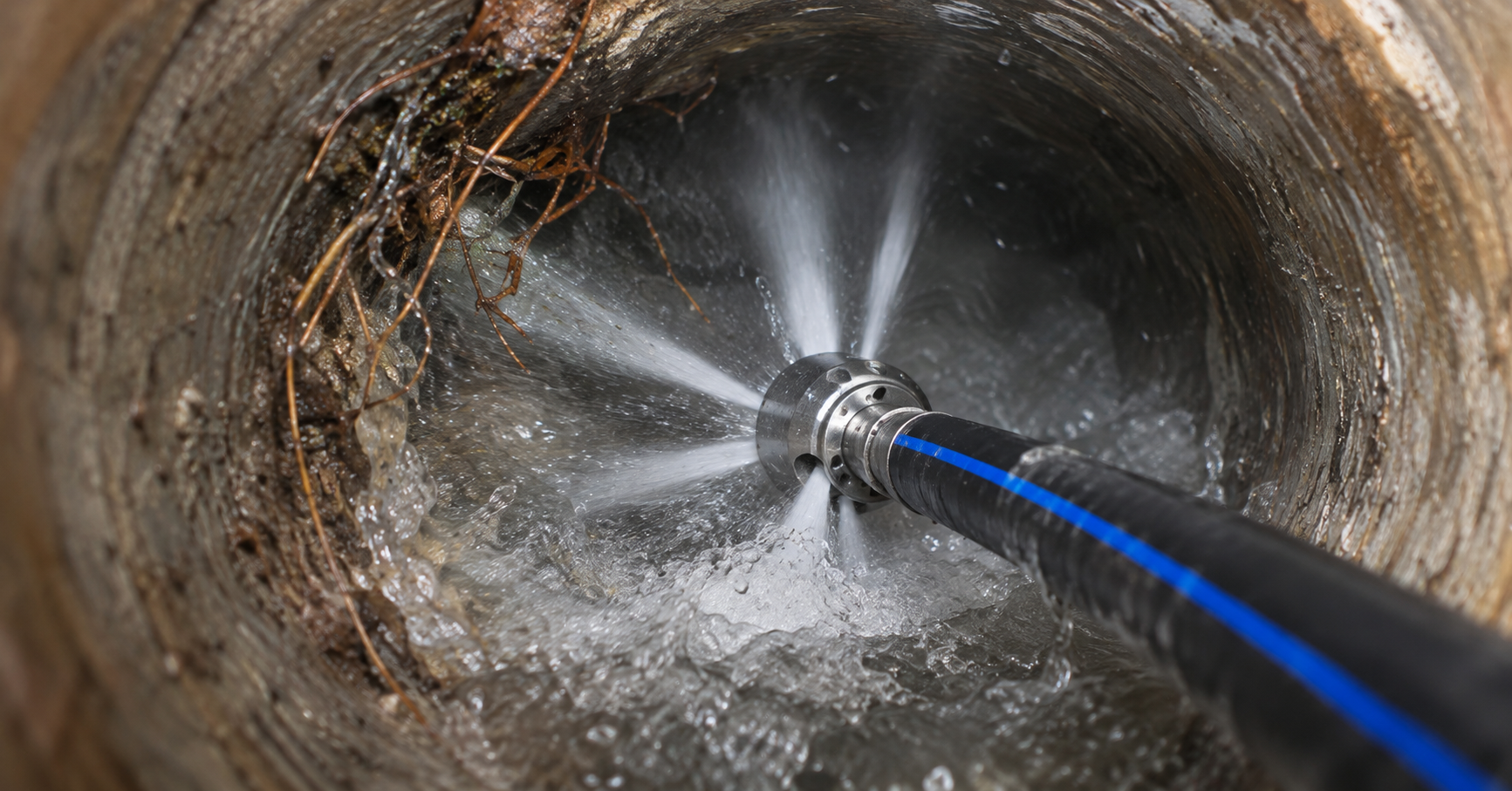
Hydro jetting uses a specialized hose with a nozzle on the end that sprays water at extremely high pressure, typically somewhere in the range of 1,500 to 4,000 PSI depending on the equipment and the pipe. The nozzle is fed into the line and pulls itself forward using rear-facing jets, blasting water in every direction as it goes. Front jets cut through the blockage itself, while the rear and side jets scour the full interior wall of the pipe clean as the hose is pulled back out.
That last part is the key difference from snaking. A snake, even a good one operated by someone who knows what they’re doing, punches a hole through a clog so water can flow again. It doesn’t clean the walls of the pipe. Hydro jetting does both: it clears the immediate blockage and strips away the layer of grease, scale, sludge, and debris built up along the entire length of the line.
Hydro Jetting vs. Snaking: How to Tell Which One You Need
Neither one is universally “better.” They’re suited to different situations.
Snaking makes sense when:
- It’s a single, isolated clog, like hair in a bathroom drain or a foreign object stuck in the line.
- You haven’t had repeat issues in that drain.
- The blockage is at a fairly shallow, accessible point in the line.
- You’re dealing with a straightforward household drain rather than a main sewer line.
Hydro jetting is the better call when:
- The same drain keeps clogging every few months no matter what you do.
- A camera inspection shows a buildup of grease, scale, or sludge coating the pipe walls, not just a single blockage.
- Tree roots have intruded into the line and need to be cleared out along with the buildup around them.
- The line serves a kitchen or a restaurant/commercial property, where grease accumulation is a constant, ongoing issue rather than a one-time event.
- A previous snaking fixed the symptom, but the clog was back within a few weeks.
If you’re not sure which category your situation falls into, that’s exactly what a camera inspection is for, and it’s usually the first thing we recommend before jetting a line we haven’t seen before.
Why We Almost Always Camera-Inspect First
Hydro jetting is powerful, and that’s the whole point, but it’s not something you want to run blind through a pipe you haven’t actually looked at. Older cast iron or clay pipes, especially the kind still found in a lot of established Salt Lake City and Millcreek neighborhoods, can be more fragile than modern PVC, and a line with existing cracks or significant deterioration needs a different approach than a healthy pipe with heavy buildup.
A camera inspection tells us the pipe material, its condition, exactly where the problem areas are, and whether jetting is going to help or whether we’re actually looking at a pipe that needs repair or replacement instead. It takes the guesswork out of it, for us and for you. You’re not paying for a service based on someone’s best guess about what’s down there.
What to Expect During a Hydro Jetting Service
The process itself is pretty straightforward from the homeowner’s side:
- We start with a camera inspection if we haven’t already assessed the line, so we know exactly what we’re dealing with and can confirm jetting is the right approach.
- The jetting hose is fed into the line through an existing cleanout or access point. In most cases, this doesn’t require any cutting into your pipes or property.
- The nozzle works its way through the line, cutting through blockages and scouring the pipe walls as it’s pulled back.
- We typically run a follow-up camera pass to confirm the line is fully clear and to show you the actual results, rather than just telling you it’s done.
Most residential jobs take somewhere between one and a few hours depending on the length of the line and how much buildup we’re clearing. It’s not an overnight process, and in most cases you’re back to normal water use the same day.
Is Hydro Jetting Safe for Older Pipes?
This is the question we get most, and it deserves an honest answer: it depends on the pipe’s actual condition, not just its age. A well-maintained older pipe can handle jetting fine. A pipe that’s already compromised (cracked, significantly corroded, or with failing joints) can be damaged further by the pressure. This is exactly why the camera inspection step isn’t optional for us on a line we haven’t already assessed. We’d rather spend ten extra minutes confirming the pipe can handle it than risk turning a clog into a bigger repair.
What Hydro Jetting Costs Compared to Snaking
Jetting typically costs more than a basic snaking service, which makes sense given the equipment and the more thorough result. But it’s worth thinking about the actual cost over time rather than just the price of a single visit. If you’re paying for a snaking service every few months because the same clog keeps coming back, the cumulative cost, plus the inconvenience of a backed-up drain three or four times a year, often ends up higher than a single jetting service that actually clears the buildup causing the repeat clogs. We’ll always give you a straight recommendation based on what the camera shows, not just push the more expensive option by default.
How Often Does a Line Need to Be Jetted?
For most residential lines, jetting isn’t an annual maintenance task the way basic drain cleaning is. It’s typically used to solve an existing buildup or root problem, and then annual camera inspections and routine maintenance keep it from building back up to that point again. Commercial kitchens and restaurants are the exception. Those lines often benefit from jetting on a regular schedule because of the sheer volume of grease going through them daily.
Tired of the Same Clog Coming Back? If you’ve snaked the same drain more than once this year, or a slow drain just won’t fully clear no matter what you try, it might be time to actually see what’s going on inside the pipe. Give Drain Kingz a call and we’ll take a look, tell you honestly what we find, and recommend the fix that actually solves it.